
The Speech Sound Pics (SSP) Approoch is the only self-paced phonics approach for Reception Classrooms. Get in. Get out!


The Speedy Six Spelling Activities
In spelling, pupils are taught to say a word clearly, identify the phonemes and select graphemes to represent those phonemes in writing (Department for Education, Writing Framework, 2025, p. 41).


The Speedy Six Spelling Activities were introduced to explore words containing correspondences that are not taught explicitly within the SSP Core Code. Teachers would often complete Activities 1, 3 and 5 on one day, and Activities 2, 4 and 6 on another, depending on the time available. Each activity can be completed in just a few minutes but, if time allows, can be extended to 30 minutes through discussion and exploration.
What the Speedy Six Spelling Activities develop
The Speedy Six Spelling Activities help children move beyond the correspondences taught explicitly within the SSP Core Code, encouraging them to notice, discuss and remember the wider alphabetic code. They strengthen phonemic awareness, decoding, encoding, vocabulary, working memory and word-specific orthographic knowledge through repeated analysis of spoken and written words. Although originally introduced to explore correspondences beyond the Core Code, the activities are suitable for learners of any age or grade because they can be adapted to the words and concepts being studied.
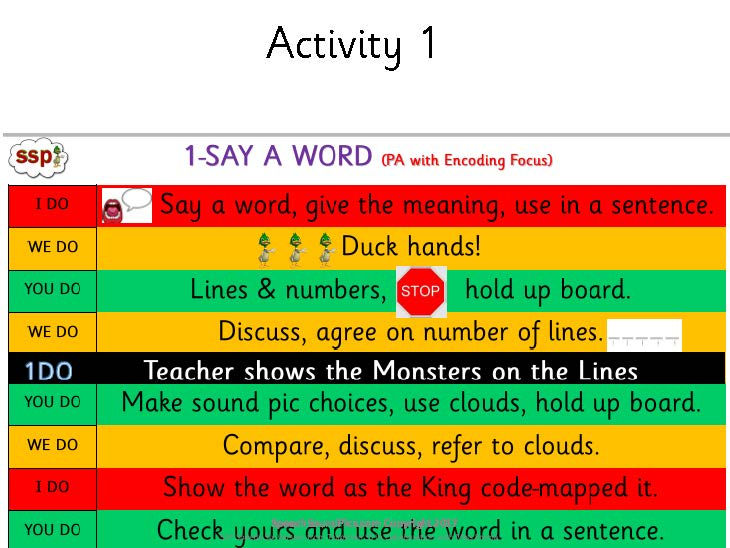
Activity 1: Say a Word
Children analyse a spoken word before seeing its spelling. They identify the speech sounds, consider the possible grapheme choices and compare these with the correct spelling. This develops phoneme-grapheme mapping and strengthens orthographic knowledge.
Activity 2: Write a Word
Children accurately write the word, identify the speech sounds and discuss alternative grapheme choices. This reinforces accurate encoding and builds knowledge of how the same speech sound can be represented in different ways.
Activity 3: Listen for a Speech Sound
Children listen for a target speech sound within sentences, identify where it occurs and discuss its spelling. This develops phonemic awareness, listening skills and the ability to connect speech with print.
Activity 4: Hold a Sentence
Children remember, write, read, check and edit sentences. This integrates working memory, spelling, punctuation, reading and self-monitoring while applying orthographic knowledge in meaningful writing.
Activity 5: Manipulating Speech Sounds
Children add, delete or change speech sounds to create new words, considering whether they are real or nonsense words. This strengthens phoneme manipulation, flexible decoding and spelling, all of which support orthographic learning.
Activity 6: Made-Up (Pseudo) Words
Children create and analyse made-up words, identifying grapheme choices for each speech sound and generating alternatives. This deepens understanding of the alphabetic code and helps children generalise their knowledge to unfamiliar words, supporting future decoding and spelling
It means that children are already familiar with the concept when they are tested at the end of Year 1 in the Phonics Screening Check. However, SSP pupils have to be told to blend the graphemes as if they are Core Code graphemes.
All pseudo-words in the check are accompanied by a picture of an alien, that is, an imaginary creature. Children are supposed to be told that when a word has a creature next to it, it is a pseudo-word. This is intended to ensure that they do not try to match the pseudo-word to a real word in their vocabulary. The reality is that huge numbers of children do not understand what this means. We know because we've asked them in England!
These words can also create issues for teachers when scoring responses, particularly when children decode 'alient words' using their own accent. For example, in 2026, some children decoded splace as s p l air s and teachers marked it incorrect. You can read about teacher responsese to the PSC 2026 here on the Phonics Reform England (PRE) site. Not reading reform, phonics reform!
Yet when I asked them to give their children 'The moon is in space', they pronounced space as s p air s, because they were using their Northern accent. They should have been given a tick. How many children just missed the pass mark because of scoring issues?
We once analysed the pseudo-word sut from the 2019 Phonics Screening Check. Using only plausible grapheme-to-phoneme correspondences, we found that it could be decoded in almost 100 different ways, assuming a British accent, and British IPA, that is, in the way those designing systematic synthetic phonics programmes would typically expect. Within the PSC only 2 were offered as acceptable responses.




The Speedy Six Spelling has been used in Australian classrooms for over a decade.
You can how engaged the children are!
This is at the heart of the Speech Sound Pics (SSP) Approach
With the two plausible pronunciations represented by <u> in during, including the one used within SSP and the one you would see if transcribing during using the IPA, i.e. /djʊərɪŋ/, <u> has nine options:
<s> → /s/, /z/, /ʃ/, /ʒ/
<u> → /ɪ/, /e/, /ʌ/, /w/, /ʊ/, /uː/, /juː/, /jɔː/, /jʊə/
<t> → /t/, /tʃ/, /ʃ/
That gives 4 × 9 × 3 = 108 possible combinations.
Spencer is exploring this mathematically using the Spelling Clouds®.
When following DfE guidance for mapping words, using phonics, phonemes and graphemes
So using the Speech Sound Pics (SSP) Approach:
-
grapheme <s> → /s/, /z/, /ʃ/, /ʒ/ = 4 phonemes (speech sounds)
-
grapheme <u> → /ɪ/, /e/, /ʌ/, /w/, /ʊ/, /uː/, /juː/, /jɔː/ = 8 phonemes (speech sounds)
-
grapheme <t> → /t/, /tʃ/, /ʃ/ = 3 phonemes (speech sounds)
4 × 8 × 3 = 96 possible combinations.
The Grapheme Rule: Every letter in a word is part of a grapheme (a letter or group of letters representing a single unit of sound). Letters are never left over or "silent".
The Reading Framework notes that “the number of graphemes in a word usually corresponds to the number of phonemes” (Department for Education, 2023, p. 41).
However some DfE resources raise questions about whether these guidelines are always dhered to, as seen here with the word adventure.

