
The Speech Sound Pics (SSP) Approoch is the only self-paced phonics approach for Reception Classrooms. Get in. Get out!


MyWordz® with MySpeekie®! Innovate UK Funded
Register and confirm your email.
You can then pay the £75 special intro price to use MyWordz.tech for 12 months.
If you would like to use the app version you can pay for licences once logged in (£5.75 per year) and use these links to access the app version with your login credentials
https://apps.apple.com/us/app/mywordz-for-members/id6739351608
https://play.google.com/store/apps/details?id=com.thereadinghut.mywordz.members


During the 10-Day Plan, if a child shows interest in a word, map it for them. All words can be made readABLE, even from the very beginning. Mapped Words® show the letters that represent graphemes, and their sound value.
This supports the child in learning all the Phonemies sounds and introduces the idea of “follow the monster sounds to say the word” using Duck Hands and a sweep to blend.
Because the word is meaningful to the child, they are more intrinsically motivated to engage with the process. This also strengthens both phonemic awareness and phonological working memory, laying essential foundations for successful word mapping and early reading.


Show the Sound Pics® (graphemes), but at this stage the focus is on the Phonemies and developing the skills needed to be ABLE to learn phonics. Use the Blue Cow if they choose this, as they will tend to over-pronounce the sound that is technically a schwa, just as they often do with their own names during the initial stages.
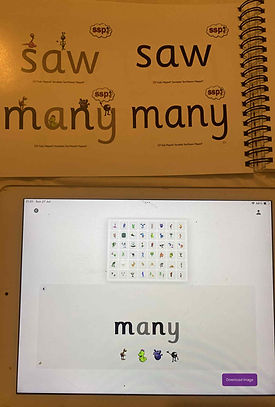
Follow the Monster Sounds to Say the Word


Mapped Wordz® matters for so many learners!
MySpeekie® gives non-speaking children a voice, can be used as a spell-check tool, supports those learning English as an additional language, and addresses the core difficulties identified in the Delphi Dyslexia Definition—phonemic awareness, phonological working memory, and language.
Use these words to talk with learners. Let them choose the words that matter to them—they’ll talk much more!
The tech is also ideal for teaching phonics, as it makes the phoneme-to-grapheme mapping visible, allowing adults to map words with learners using the whole code - the Universal Spelling Code.
Although the expected letters (graphemes) and sounds (phonemes) are prescribed by the Department for Education (DfE)—based on the International Phonetic Alphabet (IPA)—many teachers have never used the IPA and may not realise the discrepancies between the expected sounds and those used by learners when learning phonics. Without this awareness, they may miss opportunities to better support children—especially those who find phonics difficult to learn.
While the core correspondences are prescribed (as tested in the Phonics Screening Check), the expected mapping of other correspondences is often unclear—highlighting the importance of using the IPA. This tech reduces the workload for adults and provides the on-the-job word mapping training they aren’t getting elsewhere. Their learning happens because they’re using the tech.
Phonemies are child-friendly alternatives to phonetic symbols, created to make it easier to connect letters and sounds—to 'talk on paper', even if it doesn’t exactly match how we speak. This universal code is unconsciously understood by skilled readers with strong phonemic awareness. It’s how they easily store words in the orthographic lexicon and therefore recognise words on sight and know when a word ‘looks right’ when spelling—it’s all thanks to a huge brain word bank.
