
The Speech Sound Pics (SSP) Approoch is the only self-paced phonics approach for Reception Classrooms. Get in. Get out!


What are the Phonemies? They're the SSP Speech Sound Monsters.
Instant visual support for bidirectional word mapping. Show the Code!
You know the words - so what are the monster sounds?
This demonstrates what is called an opaque orthography.


Phonemies® show the phoneme (speech sound value) represented by graphemes (Sound Pics®) the child doesn’t yet know.
What is MyWordz® Show the Code™ Word Mapping Tech? Funded by Innovate UK | Women in Innovation 2026. Here is a free overview video for parents, teachers and anyone invested in ending illiteracy, promoting self-teaching and advancing social justice: ShowTheCode.com.

If the child is unsure of the Monster Sounds, use the Phonemies® screen at MyWordz.tech or in the app. Alternatively, use the Phonemies® screen in the Monster Spelling Piano® app for tablets.


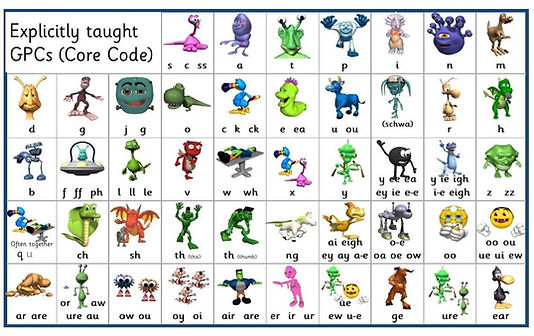
The SSP Chart shows the Core Code Grapheme-to-Phoneme Correspondences (GPCs) that the Phonemies® (Speech Sound Monsters®) correspond with.
The Spelling Clouds® show all Grapheme-to-Phoneme Correspondences (GPCs).
These are displayed as a reference but are not explicitly taught.

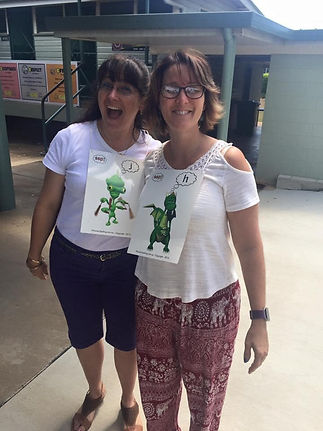
Phonemies help us connect letters and sounds throughout the day!
They show the sound value of graphemes (IPA for kids)
Phonics connects speech sounds to letters. It is the foundation of reading and spelling — a code that helps children make sense of written language.
But that code only works if it's shown in full, throughout the day. This happens through Speech Sound Play and the visual–auditory scaffolding of Phonemies, using words that are meaningful in the moment.
Synthetic phonics programmes introduce only a limited set of 'core' grapheme–phoneme correspondences (GPCs), often leaving children to guess the rest.
It doesn't have to be that way! We can Show the Code all day!
Use MyWordz® with MySpeekie® tech to show the code — live, in real time.
It’s also the perfect speech-to-print spell-check tool.
Code Mapped Words® reveal all the spelling choices for every sound, so no part of the code is missing. Check the word mapping at any time.
Making phonics more user-friendly - and therefore more effective, and fun to teach!

_edited.jpg)
By typing Phonemies® (Phonetic Symbols for Kids) and instantly seeing the correctly spelled word, children begin to notice the patterns that connect speech and print.
Every interaction supports communication while building orthographic knowledge and encouraging self-teaching of reading and spelling.
The 60 Second Routine stores the word.
They can also start from the mapped word, and practice typing as seen here.
Children will be mapping words bidirectionally ie from speech to print and also print to spell, and exploring accent variation.
Phonemies (Speech Sound Monsters) are used by SSP teachers in Australia when non-speaking children are asked to demonstrate code knowledge eg when the class undertakes the Year 1 Phonics Screening Check
If using MySpeekie as a One-Screen AAC please give parents the MySpeekie.com web site address so that they can understand it.
You can add app licences and give parents the login when you use the MyWordz.tech.com option.
We will also use the technology throughout the day to support orthographic learning. Have you signed up to join our year-long pilot with Reception classrooms in 2027?
Are Phonemies® embedded picture mnemonics?
Research has shown that picture-embedded alphabet mnemonics are more effective than disassociated picture mnemonics for helping beginners learn initial grapheme-phoneme correspondences (Shmidman & Ehri, 2010). This is logical because the information is presented together. By embedding a familiar picture within the grapheme, children make fewer discrimination errors and remember the association more successfully. They can look at the letter <a>, for example, and parrot the sound /æ/. They can then look at a word such as ant and say the associated sounds /ænt/. Of course, that does not mean they can blend the sounds together to say the word, or spell words using those sounds if they cannot hear each sound or cannot segment and blend them.
Many phonics programmes do this. They introduce 'letters and sounds' by showing a grapheme with an embedded character, such as Annie Apple in Letterland. While this can help children remember an initial grapheme-phoneme correspondence when they look at the grapheme, the character has to be ignored whenever that grapheme represents a different phoneme. This happens very early. For example, after learning Annie Apple for <a>, children soon encounter the word a in a sentence such as It is a pan, where <a> represents a different phoneme.
Our approach is fundamentally different, as it assumes every child has poor phonemic awareness and cannot easily hear the sounds in words, segment (order) and blend them, let alone manipulate them. For example, what happens if I remove the /r/ from frog? They will not say it is now fog, even if they can tell you the associated sounds when looking at the graphemes <f>, <r>, <o> and <g>.
Children need to look at a character and think of the sound, not associate it with a grapheme or a word. They may not even pronounce the word in the same way that the phonics programme expects.
If characters are used with graphemes, they must represent phonemes, not graphemes. They must be speech sound characters.
Phonemies® (Speech Sound Monsters®) represent phonemes. They are never permanently linked to a particular grapheme. Instead, they are assigned only after a word has been mapped and the phoneme represented by each grapheme is known.
During the Core Code, children quickly learn the most commonly associated graphemes for each phoneme, but the association is clear. If they see the same Speech Sound Monster® on the <e> in red, the <ea> in tread, the <ai> in said and the <a> in any, it is easy to understand and creates no stress. When words are mapped and the phoneme is shown as a direct association with the grapheme, even if they then translate it to match their accent, it is similar to an adult learning English who looks up a word using the IPA transcription.
When Speech Sound Monsters® are displayed with text, whether embedded within graphemes, shown above them or shown below them, they are always assigned according to the phonemes represented in the mapped word, aligned with the British IPA. This is the system that systematic synthetic phonics is based on.
This means the same Speech Sound Monster® appears wherever the same phoneme occurs, regardless of which grapheme represents it. For example, the same Speech Sound Monster® appears on the <e> in end, the <a> in any and the <o> in women because those graphemes represent the same phoneme in those words. Likewise, the same Speech Sound Monster® appears on the <s> in sip and the <c> in cent because they represent the same phoneme.
Conversely, when the same grapheme represents different phonemes, different Speech Sound Monsters® are used. For example, the <a> in apple and the word a represent different phonemes, so different Speech Sound Monsters® are shown.
We can see which sounds the child hears when they do the Monster Routine, even if they are non-speaking. They start by laying out the sounds in the order they hear them. We can therefore use this as a diagnostic tool for phonemic awareness. This is the foundation of Dys-Code® screening for dyslexia risk at age three.
If a child's accent results in different phonemes being used, different Speech Sound Monsters® are assigned. As educators, we will understand why, as we know that child. It may be due to accent variation or challenges with phonemic awareness.
The spelling stays exactly the same, while the Phonemies® change to match the phonemes the child actually uses. Whether they are displayed independently, embedded within graphemes, above them or below them, Phonemies® always represent phonemes, never graphemes.
We do use picture-embedded mnemonics for letter formation because their purpose is different. For example, we use the Read Write Inc. letter formation phrases as seen here. A phrase such as "round the curly caterpillar" helps children remember the movement needed to form the letter correctly by remembering the correct starting point, direction and exit point. They are not being used to teach the phoneme represented by a grapheme within a word.
As far as we can determine from extensive patent searches, analyses of every DfE-validated phonics programme, reviews of many other phonics programmes used internationally, and examinations of publicly available AAC systems, Phonemies® are the world's first complete set of phoneme characters designed specifically for bidirectional word mapping across reading and spelling.
References
Ehri, L. C. (2014). Orthographic mapping in the acquisition of sight word reading, spelling memory, and vocabulary learning. Scientific Studies of Reading, 18(1), 5–21.
Shmidman, A., & Ehri, L. C. (2010). Embedded picture mnemonics to learn letters. Scientific Studies of Reading, 14(2), 159–182.
You will see that the Speech Sound Monster ʌ is used where it would technically be ə. This is because, when children segment words, they tend to over-pronounce the sound and use ʌ, even though they soon recognise the difference and begin using ə (the schwa). We prioritise what is technically correct with our goal of centring learning around the child, following a schema-driven approach.
Learn the sounds the Phonemies make - blend the monster sounds to say the word - learn to read with Mapped Words and Mapped Books! Speech Sound Monsters show the sound value for the graphemes!
Phonics with the Phonemies Family!
Phonemies are Speech Sound Monsters
The Core Code consists of around 90–100 GPCs (Sound Pics) that children can learn quickly and easily within four SSP Code Levels or Letters and Sounds Phases 2 - 5. This knowledge kick-starts the process and means that children can begin to explore the whole alphabetic code, which includes over 350 GPCs! They will encounter the vast majority of this outside of phonics lessons, during reading andwriting activties and while working through the 1, 2, 3 and Away series of 150 books.
Letters and Sounds with Phonemies: Which Letters? Which Sounds?
Learning the Monster Sounds is easy peasy! Then we just 'follow the monster sounds to say the word!'


This will help us reveal the code behind high-frequency words and store them in our mental word banks with speed and ease!
Worked through the 10 Day Plan?
Start working through the 100 books in the online One, Two, Three and Away! library.
✅ Transformative Support for the 1 in 4 Children Who Don’t Easily Read and Spell with Synthetic Phonics
MyWordz® with MySpeekie® is a groundbreaking tool that reveals the full relationship between speech and print for all English words. Lets explore words!
Children can:
✔ Speak a word and instantly see how it’s spelled, with the option to explore the individual letters and sounds
✔ Input sounds and view the correct spelling
✔ Type any word and see how to pronounce it, with clear mapping from print to speech
This empowers children to read, spell, and make sense of words independently – no memorising, guessing, or adult intervention required.
The tool provides real-time access to word mapping in both directions, covering more than 20,000 words, with new ones added daily in response to children’s requests.
Unlike most assistive technologies, this tool doesn’t simply deliver the answer. It reveals the structure of language.
It offers what synthetic phonics aims to teach but often fails to deliver – a visible and usable code that links spoken and written words.
It’s designed to support learners with challenges in phonological awareness and working memory, including those with dyslexia.
Best of all, children enjoy the freedom to explore and learn through independent discovery. What once caused stress now sparks smiles.


The missing piece of the phonics puzzle!
Exploring the universal spelling code
throughout the day!
What will we discover today?

The missing piece of the reading and spelling puzzle is what happens outside of explicit phonics lessons, throughout the day.
The ‘code knowledge’ of adults has always mattered. Researchers like Louisa Moats have shown that teachers often struggle to connect letters and sounds beyond what programmes provide. Spelling Simplfied addresses that issue!
Our new tech bridges that gap. Children are shown what teachers may not (yet) know. On the job training is cost effective, and teachers learn what they need, when they need it.
They still use their systematic phonics programme but understand far more about why reading and spelling can be so hard for so many little learners. And why they can’t get them all over the line when phonics is a separate lesson, and doesn’t connect to real world reading and writing.
I am researching a surprising phenomenon in a country (England) seemingly obsessed with phonics. I argue that the excessive attention to it, and the millions spent on synthetic phonics programmes, is more a symptom that it is not working as intended.
But more explicit instruction is not the answer. We have tried that - along with more testing - for twenty years. Fewer now read for pleasure, and that has not happened in other comparable countries such as Canada and Australia.
When teachers are not sure how phonemes and graphemes map, when supporting children as they try to read or spell unfamiliar words, they can now check using MyWordz® with MySpeekie®.
Children as young as two can use it too. It is a great tool to support speech and language skills.
When we ‘show the code’ and show all of it, as there are no restrictions on words children can see how to read and spell, it might actually be the adults who benefit most.
No one else is showing them how to map words clearly and completely or model this throughout the day. Their programmes only show them a core set of around 100 GPCs. There are over 350.
The tech does it for them. Children need their own tablet. Sorry to those fighting to keep tech out of classrooms, but this will mean they can read and spell what they like, at any time, with no restrictions or adult required for that purpose.
No waiting for help. No feeling stupid asking how to read or spell a word in front of peers. No restrictions: all words ’decodable’! Instantly!!
Phonemies show all spelling choices for every English sound, how to check the mapping of every word, and how to understand what those words mean. Better still, the way we do it means those connections are stored in the brain’s word bank, not just memorised.
When children see the word again, they recognise it instantly and know how to spell it in their writing.
They can do this at home! Schools can actually give each reception / prep parent access to the app version for £5.75 per year. They can keep exploring at home! Parents often struggle to know which letters go with which sounds too.
Word recognition and correct spelling are not all that is needed to become a fluent reader. However, they free up the cognitive resources required to get there.
We can get them all to the reading for pleasure stage far earlier.
And you can now add in a 10-day plan before starting any DfE listed synthetic phonics, so that they know how to ‘quack the code’ outside of explicit phonics lessons.
It also includes the world’s first AAC for non-speaking children. They can use it to articulate sounds during synthetic phonics lessons and to demonstrate knowledge!
Miss Emma X