
The Speech Sound Pics (SSP) Approoch is the only self-paced phonics approach for Reception Classrooms. Get in. Get out!


The Speech Sound Pics (SSP) Approach
When we speak, we use speech sounds!
‘Duck Hand’ the word and think about which letters are the 'pictures of the speech sounds' for that word?
We are going to explore all the Sound Pics® for all speech sounds!
"Duck Hand" the words, listening for the speech sounds.
Use the visual prompts at first, from the satpin handbook.
It will be easier to then use with the Sound Pics® (graphemes) - the pictures of those speech sounds, in those words.
The video lessons are shown on the Core Code page, with lots more in the ICRWY Lessons app!
All activities connect to one another, to guide children towards the self-teaching phase! The Coding Poster has all four Core Code (phonics) levels. This kick-starts self-teaching.
Everything follows a natural and logical progression, with new
skills and concepts introduced in ways that just make sense to the children. The explicit instruction is designed to encourage self-paced learning using the ready-made resources. They soon start self-teaching, as all words can be orthographically mapped.
Children need to understand how many sounds there are in spoken words, and think about the pictures of the sounds - the Sound Pics - that go on those speech sound lines (graphemes)
We do this on Activity 1 of the Coding Poster.
They pick a visual prompt and write a word or sentence in speech sound lines, showing the speech sound numbers.
They will tell you the sentence, even though there are no letters shown. This preparation for word mapping it useful for all, but vital for at least 1 in 4 including those at risk of dyslexia.
Even within the 10 Day Speech Sound Play Plan you can use the A3 Coding Poster!
This is how Speech Sound Pics (SSP) teachers teach Core Code phonics. It's very different!
Listening for speech sounds, segmenting and blending them - Activity 1 of the A3 SSP Coding Poster.
Drawing the pictures of the speech sounds - Activity 2 of the A3 SSP Coding Poster.
Even within term 1 of reception the children are exploring the WHOLE code, not just the Core Code, because of the Phonemies (SSP Monsters)


Because children can see the code and do not need to wait until they have mastered specific GPCs, it is easier to integrate word mapping (phonics) into real life – for example, the days of the week – and link it to real books.
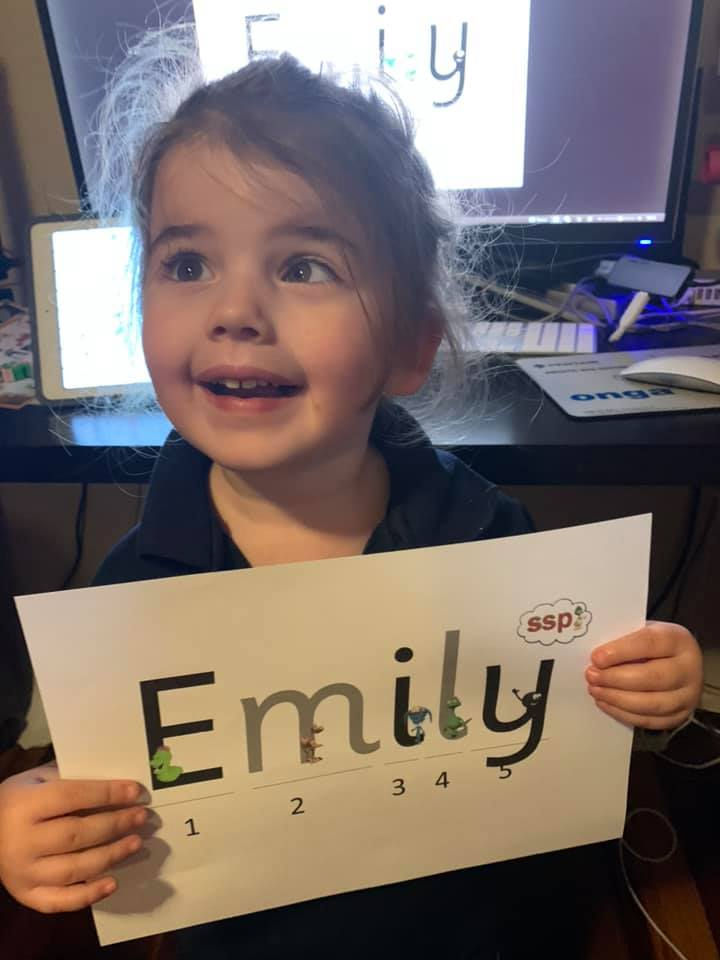
The concept of Phonemies (Speech Sound Monsters), which show us which sound to use, is introduced from day one, as all names are mapped.



The Speech Sound Connection
The idea that spoken words are built from discrete phonemes is a compelling illusion. Most people accept it without question, assuming speech maps neatly onto print. This assumption forms the foundation of how phonics programmes are designed.
But this is not completely accurate. If it was, we could simply join together the 'monster sounds' the children type, and the spoken word would be the product of those sounds in MySpeekie. But try it! Say 'yes' in phonemes and then put them back together again.
You will have to say 'yuhes'. This shows that in real speech, some sounds change slightly or blend in ways that aren't captured by breaking them down into separate parts. It is not as simple as that, and it is one reason so many children struggle to understand phonics. We need children to connect speech sounds, spelling (Sound Pics), and meaning (Speech Sound Mapping Theory), as this helps children read, rather than spending large amounts of time articulating individual 'sounds' in isolation or on phonemic awareness activities without a visual hook.
It is important that if children are shown graphemes and asked to articulate a phoneme (speech sound) that they also used this within a real word.
Use the chant strip and video lesson. They say the target phoneme - then give the phonemes in the word (of which the target is one) and then give the whole word. This helps children overcome these blending discrepancies more easily
Phonemes are not naturally occurring segments that neatly and cleanly split up words in speech. The segmentation used in phonics is a constructed system, a decision about how we will represent and work with sounds to teach the alphabetic code. Because of this, it is important to show children how the segmentation works. It’s not simply a case of listening for the sounds and mapping them to letters, or putting together phonemes when looking at graphemes. A bit of cognitive blending gymnastics takes place! The more words are mapped, and the more children begin to understand the 'rules' for mapping phonemes and graphemes, the easier it becomes to read and spell words. With good phonemic awareness, this process is much easier. Without it, these activities help to develop it.
Regular synthetic phonics activities tend to miss much of this and can be incredibly difficult for children at risk of dyslexia, or for those with ADHD or autism who need the mapping to feel more mathematical, to add up and make logical sense.
Visual support plays a key role here. By using Phonemies as visual representations, we can show children how the sounds in a word have been separated for the purposes of decoding and encoding. The more they see the Phonemies and learn to 'follow the monster sounds to say the word', the more easily they can understand how letters are linked to those speech sounds. It helps make an abstract mapping system visible and learnable, and it applies to all words.
This makes it a world first. There is no other system for children that provides a visual for a speech sound that works across the entire English lexicon.
The Code Mapping Tool is also a world first. It shows the expected segmentation of words into graphemes, supporting consistent and transparent instruction. Powered by Ortho-Graphix