
The Speech Sound Pics (SSP) Approoch is the only self-paced phonics approach for Reception Classrooms. Get in. Get out!


Show which letters are the graphemes! Have a free play with our Code Mapping® Tool
Have a free play here


We show children words that are orthographically mapped to reveal the universal accepted (phonics taught) graphemes and their speech sound values (phonemes). This is print to speech learning, supported by prompts that help children understand the correspondences, even without explicit phonics instruction. Children can also map words in the other direction. They use MySpeekie® to type in Phonemies and see the correctly spelt word. The Spelling Routine supports this process. This is speech to print learning.
Both directions are needed to secure words in the orthographic lexicon (the brain’s word bank). Different learners may prefer different starting points. For example, autistic children often prefer to see the fully mapped word first, so they can clearly see which letters correspond to which Phonemies. This is one reason they may not engage with synthetic phonics programmes. Another is that they often want to explore interest words, rather than being limited to those containing only the GPCs they have already been taught. The Word Mapping tech facilitates this.


Because spoken words are not actually made up of neatly segmented and blended phonemes, a bit of cognitive blending gymnastics takes place within phonics instruction, to make the letters and sounds 'fit'.
Phonics programmes manufacture this for a purpose, but it's important to recognise how often the two do not align easily. The more words are mapped, and the more children begin to understand the mapping phonemes and graphemes, the easier it becomes to read and spell words. In most cases, when you simply 'Show the Code', children will understand the Speech Sound Connection without explicit instruction.
MyWordz® tech includes the Code Mapping® Tool
This segments the words into black and grey and is an incredible innovation, designed by a neurodivergent educator!
It is much easier to develop orthographic knowledge when the graphemes are clearly shown.
This segmentation is possible thanks to a ground-breaking Code Mapping® algorithm that maps words in both directions.
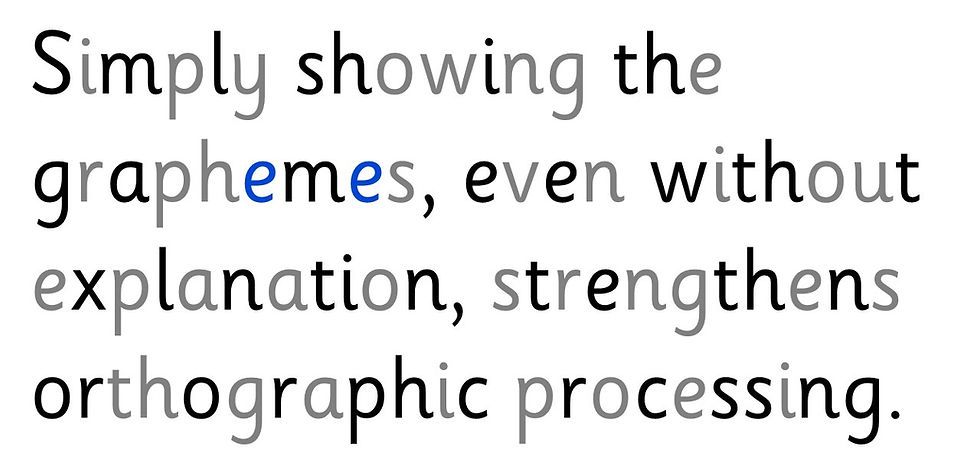

Have a free play with the world’s first word mapping tool that shows the graphemes for every word. The Orthographic Mapping Tool adheres to the phonics principle aligned with the Reading Framework, which defines a grapheme as a letter or group of letters that represents a single phoneme, and explains that the number of graphemes in a word usually corresponds to the number of phonemes, hence the term grapheme–phoneme correspondence (DfE, 2023, p. 34). For Word Mapping Mastery children need to understand phoneme-to-grapheme mapping too! When the focus is primarily on print to speech mapping at least 1 in 4 will struggle to read with fluency and comprehension, and spell proficiently.
This matters for parents and teachers because word mapping should be simple. With the exception of two words in English, there is a grapheme available for every speech sound, or phoneme. While pronunciations can vary by accent, there is a shared baseline that phonics programmes follow. This works in the same way as the International Phonetic Alphabet, which provides a common reference for pronunciation, even though millions of speakers may pronounce a word differently in everyday speech. It gives everyone a shared starting point.
When a word is mapped, each phoneme needs its own grapheme. For example, if you type story, the phonetic representation is /ˈs t ɔː r i:/. That means the word hass five graphemes: s - t - o - r - y. Making this structure visible removes guesswork and helps children, parents, and teachers see how spoken words connect to print, one sound at a time.


Show the Code!
Check the Sound Pics (graphemes)

With the MyWordz® tech, we Show the Code: both graphemes and phonemes are made visible using intuitive visual supports.
The connection between speech sounds (phonemes) and Sound Pics (graphemes) is understood, and Lara can apply word mapping in both directions: decoding when reading and encoding when spelling. This really matters!
When we'show the code' early, with BOTH graphemes AND phonemes made visible, we prevent learning difficulties.
This also offers on-the-job training for adults who have often never even heard of the IPA.


The only 'true' red words! Words that don't map.
Show the Graphemes AND Corresponding Sound Value with MyWordz® tech!

The WHOLE Alphabetic Code represents the system we navigate effortlessly as skilled readers, often without even thinking about it. But how do we know it all?
Interestingly, teachers in England - where phonics is mandated- are constantly telling me they find the Spelling Clouds® on their wall so useful, as they highlight just how much children are expected to discover through inquiry learning. After all, teachers only explicitly teach the correspondences shown on the outside of the Spelling Clouds®. It's as if they hadn't realised that they only teach around 100 GPCs and yet the whole alphabetic code has over 350!
This helps them understand why 1 in 4 children in England can't read by the end of primary school.
No, we can’t explicitly teach the whole code. So, what’s missing for the children who don’t figure out the rest? Why can't they transition into the self-teaching phase. And that's why they then realise why I gave them the 10 day plan, to use BEFORE starting a phonics programme.
You can access these Spelling Cloud® clips for free on this SpeechSoundPlay.com website: Speech Sound Play before Speech Sound Pics® and Speech to Print. Use the drop down menu under Show the Code.
You can also use the YouTube playlist.
All clips - under 2 minutes long - are easy to scroll through and find in the ICRWY Lessons app.
When I've finished there will be 48. So time consuming, but I hope helpful to all, and great discussion starters.
Miss Emma x
