
The Speech Sound Pics (SSP) Approoch is the only self-paced phonics approach for Reception Classrooms. Get in. Get out!


What is the Speech Sound Pics (SSP) Approach?
SSP is the neuroinclusive phonics system designed to kick-start self-teaching within the neurodiverse classroom setting
The first self-paced, whole-class phonics approach to bidirectional word mapping. Use SSP at home! Get in. Get out. Let self-teaching take over.
If we take pictures of Speech Sounds, what might they look like, in that word?
Speech Sound Pics are graphemes. It's easier for little ones to understand the concept of letters being used to represent speech sounds in written words. It is also easier for them to understand when they can check the graphemes and phonemes for every word with the MyWordz® with MySpeekie® tech!


Interested in piloting Spelling Simplified? Try the MyWordz® with MySpeekie® technology in your Reception classroom for 12 months, from September 2026 (England) or January 2027 (Australia), with free web and tablet access to the platform and online support throughout the pilot.
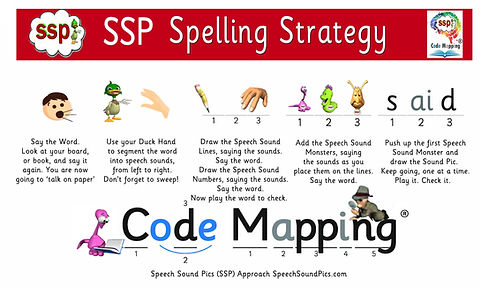
When children have written a word that is not spelt right, or they want to check it before trying it, type the sounds on the Phonetic Keyboard, with Phonemies® as Phonetic Symbols for Kids, to see the spelling and hear it voiced if useful. They can then use Check Mapping. Simply say the word to see the graphemes and their corresponding sounds. This is guided self-teaching that soon needs no guidance, as the child can teach themselves the orthographic knowledge they need using the technology. They then do the 60 Second Spelling Routine to store the word in the orthographic lexicon for instant recognition in future and accurate spelling when writing.
This is the future of "only as much explicit instruction as needed. No more." It is Spelling Simplified.
Email Support@SpeechSoundPics.com in condidence


What is the Speech Sound Pics (SSP) Approach?
A whole class self-paced approach to visual and linguistic phonics. Children are taught about Speech Sound Mapping
Video overview, for those who prefer to watch rather than to read.
The Speech Sound Pics® (SSP) Approach, originally developed in Australia by Emma Hartnell-Baker, known as Miss Emma, The Neurodivergent Reading Whisperer®, is an innovative method of teaching phonics and spelling in Reception and Year 1. It makes the link between speech and print explicit and accessible.
Why was the whole class approach called the Speech Sound Pics® Approach?
Speech Sound Pics® are the “pictures of speech sounds” – the letters or letter groups (graphemes) that map to each phoneme in spoken English.
Unique Features
-
Ortho-GraphiX® mapping system including the Code Mapping® algorithm: Shows children which letters belong together, to represent the Universal Spelling Code, highlighting the Sound Pics® that represent each spoken sound.
-
Speech Sound Monsters® (Phonemies®): Make the sound value of each grapheme unmistakably clear – a process we call Monster Mapping®.
-
Mapped Words®: A trademarked feature unique to the SSP Approach that supports orthographic learning and long-term literacy. Monster Mapped Words® and Code Mapped® books can be accessed at SpeedieReadies.com including the One, Two, Three and Away! series. Non mapped versions can be ordeed by libraries through Gardners and other official book suppliers, published by The Reading Hut Ltd
Why It Works
The Speech Sound Pics (SSP) Approach is an evidence based bi-directional word mapping approach to teaching phonics grounded in orthographic learning and knowledge, which underpin all literacy. By “showing the code”, with The Code Overlay the SSP appproach embraces linguistic diversity and neurodiversity, making it a neuroinclusive solution for all learners. The goal is Word Mapping Mastery® for all learners.
Support for Dyslexia and Diverse Learners
Understanding and practising the connections between speech sounds and spelling is at the heart of effective support for learners with dyslexia or other neurodivergent profiles. The focus is always on individual learning needs.
NeuroReadies: Children who learn differently need to be taught differently.


Quacking the Code! Mapping Speech Sounds to Speech Sound Pics
If you choose to move from Day 10 to the Speech Sound Pics Approach, rather than a whole class synthetic phonics programme, phonics curriculum content is taught through a 30-minute daily routine that is usually completed by the end of Reception (half the time of a synthetic phonics programme). All children are expected to recognise and blend the 100 or so Core Code GPCs within that time frame, thanks to the activities and the ability to learn at their own pace.
The Speech Sound Pics Approach is predominantly a visual and linguistic phonics whole class approach, with a focus on understanding how to map words and how letters and sounds connect in both directions: from speech to print (spelling) and from print to speech (decoding). The Speech Sound Pics (SSP) Approach is used across Australia.
Regardless of the synthetic phonics programme used, which is primarily print to speech with a focus on decoding, you can use Speech to Print Spelling as a separate activity with a focus on spelling. The DfE separates the two, so there is no issue running a synthetic phonics programme to teach decoding and also using Speech Sound Play (SSP) Spelling to teach encoding. Use MySpeekie® and the Monster Spelling Piano for Speech to Print Spelling in the Early Years. This ensures that linguistic and neurodiversity are embraced.


Phase 2 in Classrooms Starts after Speech Sound Play with Phonemies (the 10 Day Plan)
The 30-Minute Phonics Routine begins:
-
5 minutes – Solo or Paired Decoding
-
5–8 minutes – Coding Poster Lesson (ICRWY Lessons app)
-
10–15 minutes – Coding Poster (using an A3 coding poster to include the HFW section):
-
60–90 secs – Phonemic awareness activity
-
60–90 secs – Sound Pic (grapheme) formation and recognition
-
90 secs – Blending of Code Level Sound Pics
-
90 secs – Chants
-
120 secs – High-frequency words
-
120 secs – Code Level Sentences (Sound Pics with HFWs)
-
Additional Word Mapping Mastery activities are gradually introduced, including:

Also do these activities at home, or as an intervention for those who struggled to learn phonics with a synthetic phonics programme.
This is an easier way for autistic children to learn to decode as it makes more sense to pattern seeking brains.

The Speech Sound Pics (SSP) approach has been used in Australian classrooms for over a decade.
There are too many elements to share, but here are a few.
Child centred, personalised self-paced learning is at the heart of the Speech Sound Pics (SSP) Approach. It is so much more than phonics! We focus on grammar and punctuation, writing, comprehension...and it's always FUN!
Decodable Reader Guide
-
MyWordz® is used in Speech Sound Play to play words in speech sounds and as a one-screen AAC to support speech and phonemic awareness.
-
Within the SSP Approach, MyWordz® is used throughout the day to map words bidirectionally, support speech and check spellings.
-
The aim is for every child to master the SSP Core Code by the end of Reception, so Year 1 can focus on reading widely and writing as much as possible rather than continuing explicit phonics instruction.
-
From the Yellow Code Level, children begin Speedie Readies® while still within the SSP Approach.
-
The Village With Three Corners Scheme Handbook supports the Speedie Readies® reading, comprehension, writing, grammar and punctuation activities.
SSP Core Code : GPCs in Core Code Chants
Every example word is fully decodable at that Code Level, based on the child's existing knowledge. For example, apple would not appear in the Green Code Level because it contains the graphemes <pp> and <le>, which have not yet been introduced.
Green Code Level
<s> sip
<a> ant
<t> tap
<p> pan
<i> pin
<n> nap
Purple Code Level
<m> man
<d> dog
<g> gentle, giggle
<o> hot dog
<c> cat, cent
<k> kitten
<ck> duck
<e> end
<u> up
<r> rat
<h> hat
<b> bus
<f> frog
<l> lamp
<le> little pigs
<ll> hill
<ss> grass
Yellow Code Level
<j> jellyfish
<v> van
<w> win
<x> box
<y> fly, happy
<z> zoo
<zz> buzz
<ch> cheese
<sh> ship
<th> this, thumb
<ng> King
<ai> rain
<ee> wee
<igh> light
<oa> boat
<oo> look, moon
<eight> eight, height
Blue Code Level
<ar> car
<or> for
<ow> cow, tow
<oi> soil
<air> hair
<ur> purse
<er> perfect
<ay> play
<oy> toy
<ou> out, group
<au> August
<ir> stir
<ie> pie, chief
<ue> blue, cue
<ea> peanut, head
<ui> suit, pursuit
<ey> they, key
<aw> claw
<wh> wheel
<ph> dolphin
<ew> few, chew
<oe> toe
<ure> sure, cure
<are> are, stare
<ear> fear, bear
<ge> prestigue
Split digraphs
(Sound Pics Sandwiches)
<a-e>
cake
<e-e>
athlete
<i-e>
bike
<o-e>
note
<u-e>
flute, cute
We aligned the Speech Sound Pics (SSP) with ACARA
Core Code Links (this document is out of date, it was prepared in 2017)