
Welcome to The Speech Sound Pics (SSP) Approach, with the Ten Day Speech Sound Play Plan, part of the Word Mapping Mastery system®. Letters that function as graphemes in words are known as sound pictures, that is, Speech Sound Pics. We show the Code through the Code Mapping Algorithm, with Phonemies - Speech Sound Monsters - making the sound value visible.


Use the Speech Sound Pics (SSP) Approach in the Classroom and Speedie Readies in the early years and as 1:1 Support
Speedie Readies is designed for those teaching children to read and spell on a 1:1 basis. Prevention is easier than intervention, so start from birth. This is the only system that shows the code and includes activities that enable children to understand and apply word mapping independently, supporting self-teaching.
The goal? Early, easy, reading for pleasure! We use the Village With Three Corners books as soon as they have mastered the Purple Code Level.
Reading and spelling begin long before children are taught phonics. Speech Sound Mapping can start from birth.
Use Duck Hands® to develop phonemic awareness, the ability to isolate, segment, and blend speech sounds.
If they can do this, they can read and spell with ease. Speedie Readies!


The Speech Sound Monsters®, members of the Phonemies Family, offer a direct route to the speech sound, reducing confusion and cognitive load. English has an opaque orthography, so each sound can be represented by far more graphemes than we can explicitly teach. We therefore map words and show learners the Code, enabling them to read a much wider range of texts, regardless of existing code knowledge. So simple, so effective, so empowering.
Use Spelling Clouds® to check the speech-to-print correspondences. Start the 50 mapped One, Two, Three and Away! books with a Speedie Readies membership


IPA-aligned Phonemies are Speech Sound Monsters®. They show children the speech sound value of letters. Letters are pictures of speech sounds (Speech Sound Pics®), making word mapping visual, linguistic, and fun. Preventing the dyslexia pardox!
Speedie Readies 'Upstream Screening'
Within the first week of the Speedie Readies System in Reception and Year 1- to prevent the dyslexia paradox - you will use the Monster Spelling Piano® app for tablets to screen for phonemic awareness and phonological working memory.
You will also begin exploring speech-to-print word mapping using Duck Hands® and Phonemies®.
Miss Emma gives an overview of the
Monster Spelling Piano app.
Speedie Readies: Preventing the Dyslexia Paradox
The plan for Speedie Readies as a 'prevention to avoid the intervention' in schools is included.
Get involved in preventing the dyslexia paradox!
Speedie Readies as a one-to-one, ten-minute-per-day intervention for children in Reception, Year 1, and Year 2 continues for as long as needed, from a few weeks to two terms. Sessions continue until each child reaches the self-teaching phase and can read through the One, Two, Three and Away! series with independence and confidence. A TA who loves stories and playing with children can lead the Speedie Readies 'word discovery sessions' The ideal time to start this as a 'prevention to avoid the intervention' is term 2 of Reception.
Parents can can do this with their child!


Prevention is easier than intervention. Show the Code. Check the Tech. Change the outcome.

.png)


Less teaching, more self-teaching.
The science around how best to teach reading is not settled and is constantly evolving.
No clear empirical evidence supports a reductive, singular approach to reading. All we know for sure if that children must be ble to connect the letters that are graphemes, and the sounds (phonemes) they correspond to. Phonemies - spelt with an i - represent those speech sounds, and our code mapping algoithm shows the graphemes. It is the only in the world that does this.
We know from decades of research and theory that reading is far more complex and nuanced than most “science of reading” advocates claim. However, what everyone agrees on is that moving towards orthographic mapping relies on the brain connecting letters and sounds in both directions.
That is why phonics was created – to kick-start the process with around 100 commonly used GPCs. This is primarily print to speech, that is, grapheme-to-phoneme correspondences (GPCs).
However, we still see, to this day, that schools also teach hundreds of high-frequency words as whole words to be memorised by sight. Why? Because so many of these words include GPCs that are never explicitly taught, yet teachers know those words matter. They are everywhere. They just haven't figure out how to teach them all - because they can't.
Phonics instruction is restrictive, and the full 350+ correspondences (as seen in our Spelling Clouds) are not shown. The hope is that children start to self-teach, to understand this whole code via implicit learning.
We know that many children learn to read and spell with this kick-start, but 1 in 4 are not reading in England by age 11. Synthetic phonics has been mandated for over a decade, which is long enough to see how many children still do not get there with this initial boost. They may pass the PSC or a phonological awareness screener but still cannot read fluently. One in four is huge. They need to be shown the whole code. This is the problem we have solved.
At least 1 in children cannot look at a word and self-teach through recoding, even if they can deduce it. They are not applying Set for Variability (SfV) to adjust their pronunciation when decoding, and they are not storing words or reaching the stage of learning more about “the code” by exploring the code or learning more about reading through reading. After two years of daily systematic phonics, they are stuck, and many are tired of trying. They can decode “and” but not “any”. They cannot use a dictionary because the sound they hear does not match the expected first grapheme.
That is the problem we have solved. They can use the MyWordz® tech to check the universal spelling code, in the way that adults who do not speak English as a first language check the International Phonetic Alphabet (IPA). Lots of other things can prevent children from reading with fluency and comprehension but this one was a pretty good hurdle to overcome.
There is no “phonics instruction” here. Avery is simply shown the code. His brain can then bond the speech sounds, spellings, and meanings. We know this happens naturally for children who do not struggle, but this approach gives every child the same information. Add meaning and the system works.
Children learn the sounds of the Phonemies (Speech Sound Monsters) very quickly because they love them. They can also be used as a fun way to practise pronouncing sounds. And let’s be honest, what two-year-old wants to repeat isolated sounds unless there is a fun character in front of them doing the same thing?
It is an easy way to show the bi-directional nature of the code and to talk about the sounds you use when speaking. Phonics is, in many ways, a manufactured system. A lot of mental gymnastics needed.
No one else is showing how letters and sounds connect for any word of English, because no one else has transcribed phonetic symbols to graphemes and then back again, and created tech that uses the algorithm to make the whole code visible. It's a work in progress but kids are not only reading early - with very little instruction - but becoming children who choose to read. And as reading is mainly achieved through implicit learning we want more of that happening. No?
The science is very clear that understanding these connections between letters and sounds is what children do when they become readers. How to ensure that every child can do this, however, is not settled science.
We only know what we know until we know more.
Showing children how letters and sounds connect within an opaque orthography from birth is common sense. As far as I am aware, I was the first in the world to do this. Imagine if people had celebrated the breakthrough rather than doing everything possible to discredit it.
Show me how you ensure that every child understands the bi-directional nature of the code when working independently before you come at me. And start by explaining why showing the mapping of words, even just to align with how phonics is taught, is not simply an extension that supports word mapping.
Children learn all the Phonemies - Speech Sound Monster Sounds - in about two weeks. If they do this as toddlers it's even easier. It is us adults who struggle, not only because of brain plasticity/ memory etc but because as skilled readers we no longer think about how letters and sounds connect. That becomes a problem when trying to teach children to do it. People often tell me, “You can’t sound out the word said.” I ask them if they can say it. Then I ask what sounds they use when they say it, and which letters might represent those sounds. To a three-year-old, that makes sense.
Why do adults overthink it? Letters and sounds connect. We are simply showing how, with Phonemies instead of phonetic symbols. Anyone teaching English as another language uses the IPA to know how to pronounce words. This is no different. I have not reinvented the wheel; I have just given children phonetic symbols they are actually interested in. This reduces cognitive load.
And now the technology does it for them. They can type sentences using sounds and see the spelling, or type a word and see the mapping. And next steps are that we show the code for any book they want to read, at the time they want to read it.
Makes sense, doesn’t it? Give brains all the information they need. Less teaching, more statistical learning :-)
The 10-Day Speech Sound Play Plan is the pre-phonics speech-to-print lead-in to teaching children that the pictures of speech sounds are graphemes. We call these sound pictures Speech Sound Pics®. The plan is used in Reception before teaching phonics to screen for dyslexia risk and to support speech sound processing skills and awareness of how speech and print connect.
Use this at any stage, and spend as much time as you need if you are not using it whole-class and rushing to teach the first set of graphemes because this is mandated by the school system.
The Speech Sound Pics (SSP) Approach is our whole-class approach to teaching phonics as a kick-start into self-teaching and word mapping mastery. Speedie Readies can be used 1:1 with children, with only a two-hour training session, with no prior experience of the Speech Sound Pics (SSP) whole class approach, and it prevents reading and spelling difficulies through a Dual-Route Learning Pathway. Start Speedie Readies from birth.
If you are a parent, tutor, or TA working in schools, ask about Speedie Readies training. Help us reject the Wait to Fail approach, by preventing the the Dyslexia Paradox. Join the movement and support inclusion.


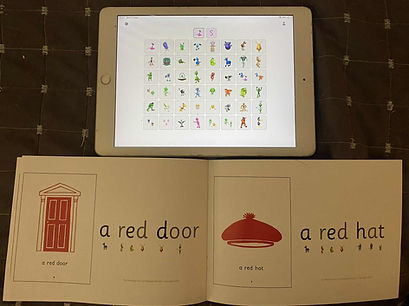

You'll have heard of coloured overlays for dyslexia. We don't use coloured overlays, we use the Code Overlay! Show the Code.
"If they don't know it, show it!"
Learn how to use books with Code Overlays on Speedie Readies.
Children will store words more easily in the orthographic lexicon if you use The Spelling Routine using Mapped Words®.


Don't Wait. Use Speedie Readies from Birth.
Alfie is autistic and had not been able to decode words with the very first set of graphemes, i.e. m, a, s, t, i, n, p, even after two years. He became highly stressed when asked to do so. More Read Write Inc. was not the answer.
First, we needed to address the underlying phonemic awareness issues and then show the code so that the letters that go together and the sound value for those graphemes connect visually. This also takes a speech-to-print approach so that the nature of the orthographic code was not confusing to Alfie. For example, <a> can be a picture of the sound at the beginning of the word ant, but a different Phonemie appears in the word any. That makes sense to his brain, as he is being given all the information needed to arrive at the word, supported by his newly developed phonemic awareness. Having the Story Peg People act out the stories adds another dimension to the process.
Alfie is now thriving and enjoying reading. He has just entered the self-teaching phase and is using recoding and his eyes are spending less time on each individual word.
He is not just decoding more easily; he is predicting and inferring, and experiencing pleasure in getting to know the characters. He is not keen on Percy Green, who can be ‘naughty’, as Alfie has a strong moral compass. Being able to talk about things such as people not always being ‘good’ has been invaluable for him, as it was something that once made him feel very anxious.
At the Early Dyslexia Screening Centre, we screen for risk before children are taught to connect letters and sounds with phonics, to ensure that we prevent issues. Prevention is far easier than intervention.
If you support children in Reception and Year 1, please get in touch and follow SpeedieReadies.com. We cannot stand by and watch the impact of a ‘wait to fail’ approach, and synthetic phonics is not going to prevent reading and spelling difficulties for one in four children. By the time they take a PSC at the end of Year 1 we can no longer prevent reading and spelling difficulties. At that stage they need intervention. The window for prevention in Reception and Year 1 - ages 5 - 7 - has passed. We MUST change this. We CAN change this. It's also far easier when we start with Speech Sound Processing Play (SSP Play) Birth to Three.


In the first few weeks Alf had a lot of issues detaching the
sounds from the graphemes at first - eg when reading the word 'a' - ie a red house. He wanted to say the sound he was told to connect it with in Read, Write Inc. It does represent that sound in some words eg ant - but not in all - think any, another, want, was, orange, water etc. The a can represent at least 9 sounds in English.
He was stuck on just one, as so used to being taught with a print-to-speech approach.
He now thinks 'what is the sound in THAT word' That's was a HUGE break-through.
Even if you only use the Word Mapping for Accents tech the children will understand how letter and sounds connect more easily - in the accent of the phonics programme or their own.
Speedie Readies includes a one-to-one, ten-minutes-a-day support system that helps children understand how words are mapped to speech and meaning, with prevention at its core rather than intervention. A TA can lead this in Reception and Year 1 from Term 2. Please also use the 10 Day Speech Sound Plan before introducing phonics

Perhaps it is because very few people specialise in supporting the development of orthographic knowledge in very young children, but no one else seems to be talking about guiding children to reach the self-teaching phase. Few seem to know when a child has reached it or, if not, why not. Many are used to following phonics programmes and using sight word flashcards. They talk about “teaching reading”, yet most of the journey happens through implicit learning, and the research is very clear about that. The purpose of explicit instruction is to facilitate that process and to be completed as quickly as possible.
My determination does not only come from the feelings I experience when a young child breaks through to that self-teaching phase (which is amazing!) It is also because I can tell, even from six months of age, which children are likely to believe that their difficulties in learning to read and spell are their fault. They do not know that they would never have had to experience that if they had been taught differently. It is why we screen children so early at the Early Dyslexia Screening Centre. We must protect these children.
We live in a world obsessed with “direct, explicit instruction,” which is not suitable for many four-year-olds, especially those who are ADHD or autistic. It's also inappropriate to be taking every KS1 child through a phonics programme in the same way, and with a teacher leading a lesson from the front. It's so common place I wish educators would take a step back and see that this is not an effective way to support individuals within the neurodiverse classroom. I know the DfE is to blame for this. I can show you how to get children there quickly by making the code visible in real words they care about and in sentences, then moving them onto the Monster Mapped One, Two, Three and Away! series as soon as possible. Youo can actually do this in the classroom as a separate activity to sythetic phonics lessons, or a TA can take children out and do ths with individual children or small groups. Children see the code, for ALL words, hear the sounds with Phonemies®, and reach the Self-Teaching Phase in weeks, not years. At this point they learn more about reading by reading, and their spelling has developed because we show them how words 'work' and because by bonding speech sounds, spelling and meaning together we secure words in the word brain box. This aligns with the Science of Reading. All I have done is taken the research and my own work as an action researcher, to find a different way to teach phonics.
Many do not realise that the “best way to teach phonics” is not settled science. Synthetic phonics is simply one approach that has been mandated by the Department for Education. The DfE states that:
“The EEF considers synthetic phonics to be one of the most secure and best evidenced areas of pedagogy and recommends all schools use a systematic approach to teaching it.”
We can show them another way, one that does not leave one in four children unable to read by age 11 (DfE, 2024).
I am becoming increasingly frustrated by the spread of misinformation and the selective use of research. For example, within The Reading Framework (p. 44), the DfE states:
“There is convincing evidence of the value of systematic synthetic phonics (SSP), including the seven-year study by Johnston and Watson undertaken in Clackmannanshire, published in 2005, which has been especially influential in England.”
It certainly was influential, and worryingly so.
What is never shared with the public is that one in five children had not mastered the GPCs (the same proportion that consistently fail the PSC). Sue Lloyd, the developer of Jolly Phonics, claimed:
“Synthetic phonics provides the necessary skills that enable the majority to read and write above their chronological age. The 20% of children who have literacy problems still have a good foundation of the basics and just need more time and input.”
However, the findings reported in the final paper of the Clackmannanshire study, published in February 2005, did not support this claim. By the end of Primary 2, all the children had been exposed to synthetic phonics, including the original analytic groups.
On pages 41–44 of the study, Tables 8.1–8.6 show a decline in scores across the board. The researchers defined being two years or more behind as a “severe learning disorder”, so the figures below show the percentage of pupils who were one year or more behind. As the reader reviews these, keep in mind that the researchers note on pages 37–40 that “No main effect of background was found” in relation to all three measures. So why on earth was this mandated?

As you will read in the new One, Two, Three and Away! Teacher Handbook, only two children in my class of around twenty-five ever left the infants unable to independently read the Main Readers, and that was when I was teaching with The Village With Three Corners (One, Two, Three and Away!). It is why I tracked down the rights holder and purchased them - and was even more determined to get them back into the hands of children after my Mum died. I had already worked out how to ensure that over 90% could learn to read with fluency, comprehension, and pleasure, because I had watched my mother do it for so many years. I now know what the remaining 5–10% were missing, and why they did not develop the orthographic knowledge they needed.
They are expensive to buy for parents to buy as they have taken a long time to prepare for re-publishing, as no digital files were available, and we can't yet order large quantities. The prices will come down as more copies are sold, so please encourage your local library to order the full set. There are 92 titles available now, with the final 30 platform readers coming soon. They can be ordered by libraries through any bookseller, including Gardners. Libraries can stock them so that every child can become a Speedie Readie! 3 in 4 may not need to see the mapped versions - but they really help with spelling! When libraries buy them, the price for parents who want their own copies also comes down. It’s a win–win for home-educating families and for those supporting the one in four children being failed by synthetic phonics programmes. Let's start a Bring Back The Village With Three Corners to Libraries campaign, One, Two, Three and Away!
Research by the National Literacy Trust (2022) showed that the reading enjoyment of 8- to 18-year-olds was at its lowest level since 2005. We can change that, but only if we stop mandating synthetic phonics programmes and focus instead on showing children the joy of reading before they leave KS1. I have updated the handbook and revised it to facilitate Word Mapping Mastery, for the 1 in 4!
To get started you will need:
-
MyWordz® with MySpeekie® (app or web version)
-
The Teacher Handbook - revised for Word Mapping Mastery (WMM)
-
The set of 36 Monster Mapped Pre-Readers in the online library


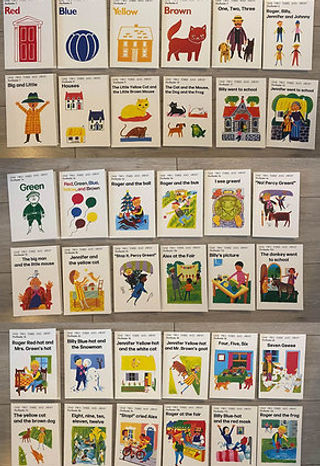


Please do ask your local library to stock the set of 92 books so that you don't need to buy them all yourself, and so that more children can find them!
We also sell them in the shop. A worthwhile investment!

Intervention with children who are older than seven is of course possible (and essential) but far harder than when we prevent reading and spelling difficulties.
Let's screen and use prevention rather than intervention in reception - please use the Ten Day Speech Sound Play Plan followed by SpeedieReadies from term 2